Howard the Duck Vs Wonder Woman Original Comic Art Pencil Sketch
| Gene Colan | |
|---|---|
 Colan at the Big Apple Summer Sizzler in Manhattan, June 13, 2009 | |
| Born | Eugene Jules Colan (1926-09-01)September 1, 1926 The Bronx, New York |
| Died | June 23, 2011(2011-06-23) (aged 84) The Bronx, New York |
| Nationality | American |
| Area(s) | Penciller, Inker |
| Pseudonym(s) | Adam Austin |
| Notable works | Daredevil Batman, Detective Comics Doctor Strange Howard the Duck The Tomb of Dracula |
| Awards | Eagle Accolade, 1977, 1979 Eisner Honor, 2010 |
| Spouse(s) | Sallee Greenberg (divorced) Adrienne Colan (Brickman) |
Eugene Jules Colan (; September 1, 1926 – June 23, 2011)[1] was an American comic book artist best known for his piece of work for Curiosity Comics, where his signature titles include the superhero series Daredevil, the cult-hit satiric series Howard the Duck, and The Tomb of Dracula, considered one of comics' classic horror serial. He co-created the Falcon, the first African-American superhero in mainstream comics;[two] [3] Ballad Danvers, who would become Ms. Marvel and Captain Marvel; and the non-costumed, supernatural vampire hunter Blade.
Colan was inducted into the Volition Eisner Comic Volume Hall of Fame in 2005.
Early life [edit]
Eugene Jules Colan[4] was born September i, 1926 to Harold Colan, an insurance salesman, and Winifred Levy Colan, an antique dealer,[5] in The Bronx,[six] New York City.[7] His parents ran an antiques business on the Upper Due east Side.[4] His family was Jewish, and the family's surname had originally been "Cohen".[8] Colan began drawing at historic period three. "The first matter I ever drew was a lion. I must've absolutely copied it or something. Simply that's what my folks tell me. And from then on, I just drew everything in sight. My grandfather was my favorite subject".[7] Among his earliest influences, he said in 2001, were the Coulton Waugh adventure comic strip Dickie Dare "in The New York Sun. I was influenced by the fashion, or the story. Mostly the story. I took information technology very seriously."[9] He moved with his family "at most historic period iv" to Long Embankment, New York, on Long Island.[9] Later, he would try to copy artist Norman Rockwell's covers to The Saturday Evening Postal service.[9] Other major art influences were comics artists Syd Shores and Milton Caniff.[7] Colan attended George Washington High School in the Washington Heights section of Manhattan, and went on to study at the Fine art Students League of New York.[4]
Career [edit]
Early career [edit]

Daredevil #48 (Jan. 1969). Factor Colan (penciler) and George Klein (inker) slip an in-joke into this Times Square scene. Whatever caused the apparent frustration, note the word at Daredevil'south left hand.
Colan began working in comics in 1944, doing illustrations for publisher Fiction House's aviation-risk series Wings Comics. "[J]ust a summer job before I went into the service",[ten] it gave Colan his starting time published work, the one-page "Wing Tips" non-fiction filler "P-51B Mustang" (issue #52, Dec. 1944).[11] His first comics story was a 7-page "Clipper Kirk" feature in the post-obit month's effect.[12]
Subsequently attempting to enlist in the U.S. Marine Corps during World State of war II but being pulled out by his father "because I was underage", Colan at "xviii or nineteen" enlisted in the Army Air Corps.[vii] Originally scheduled for gunnery school in Boulder, Colorado, plans changed with the war's sudden end. "I was going to be an aerial gunner. A bomber. Just it never materialized", he recalled in 2001.[9] After preparation at an Army army camp near Biloxi, Mississippi, he joined the U.S. forces in the Philippines. There Colan rose to the rank of corporal, drew for the Manila Times, and won an fine art contest.[vii]
Upon his return to civilian life in 1946, Colan went to work for Marvel Comics' 1940s precursor, Timely Comics.[13] He recalled in 2000,
I was living with my parents. I worked very hard on a war story, about seven or eight pages long, and I did all the lettering myself, I inked it myself, I even had a wash effect over it. I did everything I could do, and I brought it over to Timely. What you had to do in those days was go to the candy store, option upwardly a comic book, and wait in the back to see where it was published. Most of them were published in Manhattan, they would tell you the address, and yous'd simply go down and make an appointment to go downwardly and run across the art managing director.[7] Al Sulman, listed in Timely mastheads then as an "editorial associate",[fourteen] "gave me my break. I went up there, and he came out and met me in the waiting room, looked at my work, and said, 'Sit here for a infinitesimal'. And he brought the work in, and disappeared for about 10 minutes or so ... and then came back out and said, 'Come with me'. That'south how I met [editor-in-chief] Stan [Lee].[15] Merely like that, and I had a job.[7]
Comics historian Michael J. Vassallo identifies that showtime story as "Adam and Eve — Crime Incorporated" in Lawbreakers Ever Lose #1 (cover date Leap 1948), on which is written the internal job number 2401. He notes another story, "The Cop They Couldn't Stop" in All-True Crime #27 (April 1948), chore number 2505, may accept been published first, citing the differing cover-date classification ("Spring" v. "April") for the uncertainty.[sixteen]
Hired as "a staff penciler",[3] Colan "started out at most $sixty a week. ... Syd Shores was the art director".[17] Due to Colan's work going uncredited, in the way of the times, comprehensive credits for this era are difficult if not impossible to ascertain. In 2010, he recalled his first comprehend art being for an issue of Captain America Comics;[18] Colan drew the 12-page lead story in event #72, the encompass-creative person of which is undetermined.[19] He definitively drew the cover of the terminal effect, the horror comic Captain America's Weird Tales #75 (Feb. 1950),[20] which did not include the titular superhero on either the comprehend or inside.[21]
Later virtually all the Timely staff was allow go in 1948 during an industry downturn, Colan began freelancing for National Comics, the time to come DC Comics. A stickler for accuracy, he meticulously researched his countless state of war stories for DC'due south All-American Men at State of war, Captain Storm, and Our Army at War, likewise as for Marvel's 1950s forerunner Atlas Comics, on the series Battle, Battle Action, Battle Ground, Battlefront, K.I. Tales, Marines in Boxing, Navy Gainsay and Navy Tales. Colan'southward earliest confirmed credit during this fourth dimension is penciling and inking the six-folio criminal offence fiction story "Dream Of Doom", by an uncredited writer, in Atlas' Lawbreakers Always Lose #6 (Feb. 1949).[22]
By the early 1950s, he was living in New Rochelle, New York.[23] Around this fourth dimension he did his get-go work for DC Comics, and then the industry leader, on the licensed series Hopalong Cassidy, based on the film and Television receiver Western hero, cartoon it from 1954 to 1957.[24] [25] In the 1960s, he lived in New Jersey, where his and Adrienne's children, Erik and Nanci,[four] were raised.[vii]

Silver Age [edit]
While freelancing for DC romance comics in the 1960s, Colan did his start superhero work for Marvel under the pseudonym Adam Austin.[26] Taking to the form immediately, he introduced the "Sub-Mariner" feature in Tales to Astonish,[27] and succeeded Don Heck on "Iron Man" in Tales of Suspense.
Sometime subsequently Colan began this pseudonymous stint, Curiosity editor Stan Lee made overtures to lure him from DC. Colan recalled,
Stan asked me to come over and work with him. I don't remember how, but I do know that we fabricated a connection, and he asked me, "How about coming over?" And and so, my answer was — I think this was at his house; I had some work to deliver tardily one night; it was in the winter, and I went over and delivered it — and he asked me to come up over to Marvel, and I said, "Well, what'south the inducement? Why should I go out DC and come over to work with y'all, unless there's a little something in information technology for me to exercise that? I'm not just going to exit them [DC]." He said, "Well, if you're looking for more money, at that place's no point to information technology." I said, "What practice yous hateful?" [laughs] He said, "Simply considering, sooner or later, they're going to have to burn you, and you'll accept to come up over here." [laughs] I smiled, and I said, "Stan, I recollect I have to go." And I shook his hand, and I said, "That's okay, I'll just stay where I am." The next twenty-four hours, I got a phone call from Stan, because I had asked for more than money, and he gave it to me. He tried to barefaced me, and ... so I came over.[seven]
Nether his own proper noun, Colan became 1 of the premier Silver Age Marvel artists, illustrating a host of such major characters as Captain America, Medico Strange (both in the late-1960s and the mid-1970s serial), and his signature character, Daredevil. Operating, like other company artists, on the "Curiosity Method" — in which editor-in-chief and principal author Stan Lee "would but speak to me for a few minutes on the phone, tell me the beginning, the middle and the terminate [of a story] and not much else, maybe four or five paragraphs, so he'd tell me to make [a 20-page] story out of it,"[10] providing artwork to which Lee would then script dialogue and captions — Colan forged his own style, different from that of artists Jack Kirby and Steve Ditko, whom Lee would point to as examples of the Marvel style:
Whatsoever book he thought was selling, he would have the residual of the staff try to copy the same style of piece of work, only I wouldn't do it. I'd tell him if you want Stevie Ditko then you'll have to get Stevie Ditko. I tin can't practice information technology, I have to be myself. So he left me alone. ... He knew I meant information technology and that I couldn't do information technology and in that location was no betoken in trying to force me to do it. Stan recognized something in my work from the very first, whatsoever that was, that gave [me] my first big break. And I always got along very well with Stan; non everybody can say that but I did ... and so he let me do pretty much what I wanted to do ... [T]here was always some piffling change here and there, but basically he left me alone. ... And I was intimidated by Stan. I didn't want to go into his part, information technology upset me a piffling bit, just he was very dainty to me. He left me pretty much alone because I was able to deliver pretty much what he was looking for, and so we never had any trouble.[x]
Lee and Colan introduced the Emissaries of Evil in Daredevil Annual #i (1967)[28] and the Jester in Daredevil #42 (July 1968).[29] Colan's long run on the Daredevil series encompassed all simply three issues in an otherwise unbroken, 81-issue cord from #20-100 (Sept. 1966 - June 1973), plus the initial Daredevil Almanac (1967). He returned to draw 10 issues sprinkled from 1974 to 1979, and an eight-effect run in 1997. Colan admitted relying upon amphetamines in order to make deadlines for illustrating the serial Doctor Strange,[30] for which he would personally visit the character's real-life Manhattan neighborhood, Greenwich Hamlet, and shoot Polaroid photographs to utilize equally location reference.[31] Captain Marvel, a graphic symbol created to secure the trademark on the proper noun,[32] debuted in Marvel Super-Heroes #12 (Dec. 1967) by Lee and Colan.[33] The original Guardians of the Milky way first appeared in Marvel Super-Heroes #xviii (Jan. 1969) by writer Arnold Drake and Colan.[34]
In Helm America #117 (Sept. 1969), Colan and writer-editor Stan Lee created the Falcon,[35] the offset African-American superhero in mainstream comic books.[2] [iii] The character came about, Colan recalled in 2008,
... in the late 1960s [when news of the] Vietnam State of war and civil rights protests were regular occurrences, and Stan, e'er wanting to be at the forefront of things, started bringing these headlines into the comics. ... 1 of the biggest steps we took in this direction came in Captain America. I enjoyed cartoon people of every kind. I drew equally many dissimilar types of people equally I could into the scenes I illustrated, and I loved drawing black people. I always found their features interesting and so much of their strength, spirit and wisdom written on their faces. I approached Stan, every bit I remember, with the idea of introducing an African-American hero and he took to it right away. ... I looked at several African-American magazines, and used them as the footing of inspiration for bringing The Falcon to life.[36]
Concurrent with his move to Curiosity, Colan also contributed several stories to Warren Publishing's line of black-and-white horror comics magazines, beginning with the six-folio tale "To Pay the Piper", past author Larry Ivie, in Eerie #two (March 1966). At that place and in subsequent stories for that magazine and its sister publication, Creepy, Colan would ink his own pencil work. His final original Warren story, "First Blood", appeared in Eerie #xi (Sept. 1967). The vast majority of these were written by Warren editor Archie Goodwin, with whom Colan would later collaborate on Curiosity's Iron Man.[24] [37]
Dracula and Batman [edit]
Colan in the 1970s illustrated the complete 70-consequence run of the acclaimed[38] [39] horror title The Tomb of Dracula [40] as well as most problems of writer Steve Gerber'southward cult hit Howard the Duck.[41]
Colan, already ane of Marvel's most well-established and prominent artists, said he had lobbied for the Tomb of Dracula assignment:
When I heard Marvel was putting out a Dracula book, I confronted [editor] Stan [Lee] about it and asked him to permit me do it. He didn't give me too much problem merely, as information technology turned out, he took that promise away, proverb he had promised it to Bill Everett. Well, right then and there I auditioned for it. Stan didn't know what I was up to, but I spent a day at home and worked upwardly a sample, using Jack Palance as my inspiration and sent information technology to Stan. I got a call that very twenty-four hour period: 'Information technology's yours.'[42]
Colan and Marv Wolfman created several supporting characters for the Dracula serial. They introduced Bract in The Tomb of Dracula #10 (July 1973)[43] and Lilith in Giant-Size Chillers #1 (June 1974).[44] Colan became the artist of Doctor Foreign volume 2 with issue #six (Feb. 1975) which introduced the Gaea character.[45] A crossover betwixt the two Colan-drawn series occurred in May 1976.[46] In 2010, Comics Bulletin ranked Colan's run on The Tomb of Dracula 5th on its list of the "Meridian 10 1970s Marvels". His work on Doctor Foreign was ranked 9th on the same list.[47] Colan's collaboration with Steve Gerber on the Howard the Duck series saw the championship character nominated past the All-Night Party, a fictional political political party, as their nominee in the Presidential campaign of 1976,[48] and led to Howard the Duck receiving thousands of write-in votes in the actual election.[49] The Gerber-Colan team created Md Bong in Howard the Duck #15 (Aug. 1977).[50] Gerber later said to Colan: "At that place really was most a telepathic connection there. I would see something in my mind, and that is what you would draw! I've never had that experience with another creative person earlier or since."[51]
Colan returned to DC in 1981,[52] post-obit a professional falling out with Marvel editor-in-main Jim Shooter.[53] Colan recalled 2 decades later that Shooter
... hated me. I was miserable. It was the worst experience ... one of the worst I've ever experienced. I had to exit Marvel considering of him. I wouldn't stay, and I ... left everything backside. I left a pension plan, everything. I would have stayed, but Shooter gave me such a rough time. In fact, the vice president [of Marvel] had been down in a meeting with me and Shooter, trying to pacify me and become me to stay. And I but wouldn't do information technology, crusade I could see the writing on the wall, and I knew where Shooter was heading, and I didn't want any more of it.[54]
He brought his shadowy, moody textures to Batman, serving every bit the grapheme's principal creative person from 1981 to 1986, penciling most problems of Detective Comics and Batman during this time. His debut issue of the character's eponymous series was #340 (October. 1981).[52] [55] With writer Gerry Conway, Colan revived the Golden Age supervillains Doctor Death in Batman #345 (March 1982)[56] and the Monk in Batman #350 (Aug. 1982)[57] and introduced Killer Croc in Detective Comics #523 (February. 1983).[58] Killer Croc appears in the 2016 alive-action movie Suicide Team, portrayed by Adewale Akinnuoye-Agbaje.[59] Some other new character, Nightslayer, was created past Colan and Doug Moench in Detective Comics #529 (Aug. 1983).[threescore]
In the insert preview in DC Comics Presents #41 (Jan. 1982), writer Roy Thomas and Colan provided Wonder Woman with a stylized "WW" emblem on her bodice, replacing the traditional eagle.[61] The "WW" emblem, dissimilar the eagle, could be protected as a trademark and therefore had greater merchandising potential. Wonder Woman #288 (February 1982) premiered the new costume and an altered cover banner incorporating the "WW" keepsake.[62] Colan was one of several artists on Wonder Woman #300 (Feb. 1983)[63] [64] and stayed on the series until effect #305 wherein he and author Dan Mishkin reintroduced the character Circe to the rogues gallery of Wonder Woman's adversaries.[65] Steve Gerber and Colan reunited at DC to produce The Phantom Zone limited serial.[66] Helping to create new characters as well, Colan collaborated in the 1980s with The Tomb of Dracula writer Marv Wolfman on the 14-issue run of Nighttime Force featuring characters introduced in an insert preview in The New Teen Titans #21 (July 1982).[67] He was one of the contributors to the DC Challenge limited serial in 1985.[68] Additionally, Colan worked with Cary Bates on the 12-consequence run of Silverblade; with Greg Potter on the 12-outcome run of Jemm, Son of Saturn; and drew the showtime six bug of Doug Moench's 1987 revival of The Spectre.[24]
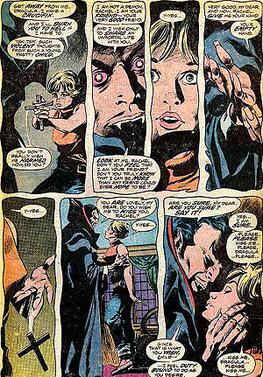
Colan folio from The Tomb of Dracula #forty (Jan. 1976). Inked by Tom Palmer.
Colan'south style, characterized by fluid figure drawing and extensive utilise of shadow, was unusual amid Silver Age comic artists,[69] and became more pronounced as his career progressed. He unremarkably worked equally a penciller, with Frank Giacoia and Tom Palmer as his most frequent inkers. Colan broke from the mass-market comic volume penciller/inker/colorist assembly-line arrangement by creating finished drawings in graphite and watercolor on such projects as the DC Comics miniseries Nathaniel Dusk (1984) and Nathaniel Sunset Two (1985–86), and the feature "Ragamuffins" in the Eclipse Comics umbrella series Eclipse #iii, 5, and 8 (1981–83), with frequent collaborator Don McGregor.[24]
Contained-comics work includes the Eclipse graphic novel Detectives Inc.: A Terror Of Dying Dreams (1985), written by McGregor and reprinted in sepia tone as an Eclipse miniseries in 1987, and the miniseries Predator: Hell & Hot Water for Dark Horse Comics. He contributed to Archie Comics in the late 1980s and early 1990s, drawing and occasionally writing a number of stories. His work there included penciling the lighthearted science-fiction series Jughead'due south Time Law #one-6 (July 1990–May 1991), and the 1990 ane-shot To Riverdale and Back Again, an adaptation of the NBC TV moving picture about the Archie characters 20 years subsequently, ambulation May 6, 1990; Stan Goldberg drew the parts featuring the characters in flashback as teens, while Colan drew adult characters, in a less cartoony style, and Mike Esposito inking both.[24]
Back at Curiosity, he collaborated again with Marv Wolfman and veteran inker Al Williamson on a new The Tomb of Dracula serial, and with Don McGregor on a Black Panther serial in the Marvel Comics Presents anthology, likewise as a six-issue adaptation of Clive Barker'due south "The Harrowers: Raiders of the Abyss."[24]
Later life and career [edit]
Colan did some insert artwork on Hellbilly Deluxe (released August 1998), the outset solo anthology of Rob Zombie, credited as Factor "The Mean Machine" Colan.[70] Unrealized projects around this time included the Marvel Music comic Elvis: Mystery Train, which went on hold, he said in 1996, "when Marvel ran into problems, so everything came to a halt. Correct now it's in limbo. Senator Daniel Patrick Moynihan's son is writing information technology ..."[71]
In 1998, Colan and his Tomb of Dracula writing collaborator, Marv Wolfman, reteamed on Nighttime Horse Comics 3-outcome miniseries The Expletive of Dracula (July-Sept. 1998).[24] Saying the book required "a much younger and better-looking Dracula" than in their previous series, Colan used "my lawn-male child [every bit] my model. ... I asked him to practise the posing and he did."[54] For the same visitor early the next decade, Colan returned to vampires with the 2001 one-shot Buffy the Vampire Slayer: Tales of the Slayers, an bus that included writer Doug Petrie's xvi-folio "Nikki Goes Down", starring a 1970s vampire slayer seen in one episode of the namesake TV serial.[24]
Colan penciled the final pages of Blade vol. 3, #12 (Oct. 2007), the last issue of that series, drawing a flashback scene in which the graphic symbol dresses in his original outfit from the 1970s series The Tomb of Dracula. That same calendar month, for the anniversary issue Daredevil vol. 2, #100 (Oct. 2007), Colan penciled pages 18–20 of the 36-page story "Without Fear, Part 1"; the issue additionally reprinted the Colan-drawn Daredevil #90-91 (Aug.-Sept. 1972).[24]
In the late 1980s, Colan, in add-on to his art, taught at Manhattan's Schoolhouse of Visual Arts and Fashion Institute of Technology,[72] and had showings at the Bess Cutler Gallery in New York City and at the Elm Street Arts Gallery in Manchester, Vermont.[73] He had relocated to nearby Manchester Heart, Vermont, from New York City in 1990 or 1991, and was living in that location every bit of 2001.[72] Past 2009 at the latest, they had returned to New York Metropolis, settling in Brooklyn.[74] [75] [76]
On May 11, 2008, his family unit announced that Colan, who had been hospitalized for liver failure, had suffered a abrupt deterioration in his health.[77] By Dec, he had sufficiently recovered to travel to an in-shop signing in California.[78] He continued to produce original comics work as belatedly every bit 2009, cartoon the 40-page Captain America #601 (Sept. 2009), for which he won an Eisner Honor.[79]
Personal life [edit]
Gene Colan was married twice: first to Sallee Greenberg, with whom he had children Valerie and Jill before the couple divorced, and Adrienne Brickman, with whom he had children Erik and Nanci.[4] [80] Adrienne Colan died on June 21, 2010.[81]
Colan died in the Bronx on June 23, 2011, aged 84, following complications of cancer and liver illness.[4] He lived in Brooklyn at the fourth dimension of his death.[1]
Awards and honors [edit]
Colan'southward collaboration with Steve Gerber on Howard the Duck received the 1977[82] and 1978[83] Hawkeye Award for Favorite Comic Book (Humor) and was nominated for four Eagle Awards in 1978.[83] Colan received an Inkpot Award in 1978 besides.[84]
In 2005, Colan was inducted into the comics manufacture's Will Eisner Comic Book Hall of Fame.[85] He subsequently won the 2010 Eisner Accolade for Best Unmarried Upshot (together with author Ed Brubaker) for his work on Captain America #601 (Sept. 2009).[79]
The Cartoon Fine art Museum in San Francisco presented the retrospective "Colan: Visions of a Man without Fright" from November xv, 2008, to March 15, 2009.[73] [86]
Colan was the recipient of the 2008 Sparky Award, presented December 4, 2008[87] and won the Comic Fine art Professional Society'southward Sergio Award on October 24, 2009.[88]
Bibliography [edit]
Archie Comics [edit]
- Archie & Friends #51 (Featuring Josie and the Pussycats) (2001)
- Archie's Pals 'n' Gals Double Digest Magazine #41 (1999)
- Everything's Archie #133, 148 (1988–90)
- Jughead #17 (1990)
- Jughead'due south Time Police force #3–6 (1990–91)
- Life with Archie #272–273, 274, 278, 285–286 (also writer for #273, 278) (1989–1991)
- Pep Comics #411 (1987)
- Teenage Mutant Ninja Turtles Adventures #22 (1991)
- To Riverdale and Back Again oneshot (1990)
Bongo Comics [edit]
- Treehouse of Horror #11 (2005)
Comico [edit]
- Bloodscent #1 (1988)
CrossGen Comics [edit]
- Rob Zombie's Spookshow International #1–iii (2003–2004)
Night Horse Comics [edit]
- Buffy the Vampire Slayer: Tales of the Slayers OGN (2002)
- Creepy: The Express Series #i (1992)
- The Curse of Dracula #1–iii (1998)
- Dark Horse Presents #117 (Aliens) (1997)
- Harlan Ellison'south Dream Corridor #2 (2007)
- Hellboy: Weird Tales #vi (2003)
- Michael Chabon Presents The Amazing Adventures of the Escapist #2, v (2004–2005)
- Predator: Hell & Hot H2o #1–three (1997)
DC Comics [edit]
- All-American Men of War #3–four, 6–ix, 43, 112–113 (1953–1966)
- Batman #340, 343–345, 348–351, 373, 383 (1981–1985)
- Batman: Gotham Knights (Batman Black and White) #15 (2001)
- Helm Storm #four, 13, 16 (1964–1966)
- DC Claiming #1 (1985)
- DC Comics Presents #41 (Wonder Woman preview) (1982)
- DC Scientific discipline Fiction Graphic Novel #2 (Nightwings) (1986)
- Detective Comics #510, 512, 517, 523, 528–538, 540–546, 555–567 (1982–1986)
- Elvira'southward House of Mystery #eleven (1987)
- Falling in Love #68, 73, 75, 81, 84, 87 (1964-1966)
- Fury of Firestorm #19, Almanac #4 (1984–1986)
- G.I. Combat #113 (1965)
- Girls' Beloved Stories #113, 115, 118, 145, 165, 167, 174 (1965-1972)
- Girls' Romances #101, 103, 106-109, 111-115, 117-119, 123 (1964-1967)
- Center Throbs #87, 89, 91, 97-98, 100, 106-107 (1963-1967)
- Hopalong Cassidy #86-122 (1954-1957)
- House of Secrets #63 (1963)
- Jemm, Son of Saturn #1-12 (limited series) (1984–1985)
- Simply Imagine Stan Lee With Jim Lee Creating Wonder Woman (backup story) (2001)
- Legion of Super-Heroes vol. two #311 (1984)
- Legion of Super-Heroes vol. 3 #27 (1986)
- Little Store of Horrors movie adaptation #1 (1987)
- My Greatest Adventure #72-75, 77 (1962-1963)
- Mystery in Space #thirteen, 26 (1953-1955)
- Nathaniel Dusk #one–four (1984)
- Nathaniel Dusk II #1–4 (1985–1986)
- The New Teen Titans #21 (Night Force preview) (1982)
- Night Force #i–xiv (1982–1983)
- Our Army at State of war #5-19, 144, 162, 169, 173 (1952-1966)
- Our Fighting Forces #86-87, 95, 100 (1964-1966)
- Phantom Zone #1–iv (1982)
- Sea Devils #xiii (1963)
- Secret Hearts #92, 94, 96-107, 109-114 (1963-1966)
- Hush-hush Origins #five (Reddish Avenger) (1986)
- Silverblade #i–12 (1987–1988)
- Spectre vol. 2 #1–6 (1987)
- Star Spangled War Stories #17-18, 20, 121, 123, 128 (1954-1966)
- Strange Adventures #30 (1953)
- Western Comics #62 (1957)
- Who'due south Who: The Definitive Directory of the DC Universe #2, eleven, 16–17, 25 (1985–1987)
- Wonder Woman #288–305 (1982–1983)
- World's Finest Comics #274 (Zatanna); #297, 299 (Superman and Batman) (1981–1984)
- Immature Love #52, 56, 61, 65-66 (1965-1968)
- Immature Romance #128, 131, 133 (1964)
Disney Comics [edit]
- Goofy Adventures #17 (1991)
Eclipse Comics [edit]
- Detectives Inc.: A Terror of Dying Dreams OGN (1985)
- Eclipse Monthly #3–iv (1983–1984)
- Eclipse Magazine #iii, 5, eight (Ragamuffins) (1981–1983)
- Stewart the Rat graphic novel (1980)
IDW Comics [edit]
- Hero Comics oneshot (also author) (2009)
Marvel Comics [edit]
- two-Gun Western #4 (1956)
- 2099 Unlimited #ix (1995)
- 3-D Tales of the West #one (1954)
- Adventure into Mystery #seven (1957)
- Adventures into Terror #3, 5, 14, 21, 24–25, 28–29 (1951–1954)
- All-True Criminal offence #46 (1951)
- All-True Criminal offense Cases #27, 31, 33–34 (1948–1949)
- Amazing Adventures #3–5 (Blackness Widow); #26 (Killraven) (1970–1974)
- Amazing Detective Cases #9 (1951)
- Amazing Mysteries #32–33 (1949)
- Amazing #12, 20, 29, 56 (1952–1956)
- Astonishing Tales #7–8 (Doctor Doom) (1971)
- The Avengers #63–65, 206–208, 210–211 (1969–1981)
- Boxing #11, sixteen-17, 19, 24, 33–35, 38, 41, 43, 47–56, 58-59 (1952–1958)
- Battle Action #viii, 15, nineteen, 21–22, 24–25, 28–30 (1953–1957)
- Battle Ground #3, 11–13, sixteen-20 (1955–1957)
- Battlefield #5, xi (1952–1953)
- Battlefront #21–22, 24–25, 27, 3–-35, 38–40, 42–43, 45–48 (1954–1957)
- All-time Love #36 (1950)
- Bible Tales for Young People #4 (1954)
- Black Rider #11 (1950)
- Bract #1 (1998)
- Bract vol. three #12 (two pages) (2007)
- Bob Marley: Tale of the Tuff Gong #i–2 (1994–1995)
- Captain America #116–137, 256, 601, Almanac #v (1969–1971, 1981, 2009)
- Captain America's Weird Tales #75 (1950)
- Helm Curiosity #1–four (1968)
- Gainsay #5, 11 (1952–1953)
- Gainsay Kelly #3 (1952)
- Commando Adventures #ane–2 (1957)
- Complete Mystery #1 (1948)
- Crime Can't Win #i (1950)
- Crimefighters #1–2 (1948)
- Daredevil #20–49, 53–82, 84–100, 110, 112, 116, 124, 153–154, 156–157, 363, 366–368, 370, #-i, Annual #one (1966–1979, 1997)
- Daredevil vol. ii #twenty (2001)
- Doctor Foreign #172–178, 180–183 (1968–1969)
- Dr. Strange, vol. 2, #half-dozen–eighteen, 36–45, 47 (1975–1981)
- Dr. Strange, Sorcerer Supreme #19 (1990)
- Dracula Lives #6, 8 (1973–1974)
- Frontier Western #one–ii, 6 (1956)
- Thou.I. Tales #v–half dozen (1957)
- Giant-Size Chillers #1 (Dracula) (1974)
- Girl Comics #iv (1950)
- Gunhawk #16, 18 (1951)
- Gunsmoke Western #35-39, 42, 72, 76 (1956–1963)
- Harrowers #1–half-dozen (1993–1994)
- Haunt of Horror #2 (1974)
- Howard the Duck #4–xx, 24–27, 30–31 (1976–1979)
- Howard the Duck magazine #1–5, 7–9 (1979–1981)
- Hulk! #xi, nineteen, 24–27 (1978–1981)
- Ideal #4 (1948)
- Iron Human being #1, 253, Annual #x, 13, fifteen (1968, 1989–1994)
- Iron Man and Sub-Mariner #1 (1968)
- Journey into Mystery #ii, 23, forty, 81-82 (1952-1962)
- Journeying into Mystery vol. 2 #4 (1973)
- Journey Into Unknown Worlds #2, six, 17, 19-20, 23, 29, 39 (1950–55)
- Justice #4–v, 7, 22, 32, 35–36, 46 (1948–54)
- Child Colt Outlaw #52, 79, 110, 112, 114 (1955–64)
- Lawbreakers Always Lose #one–2, 6 (1948–49)
- Love Adventures #2 (1950)
- Honey Romances #101 (1962)
- Love Tales #62 (1955)
- Loveland #1 (1949)
- Lovers #26 (1949)
- Human being Comics #9, 13, 21, 23 (1951-1953)
- Marines at War #5-7 (1957)
- Marines in Activity #5-half-dozen, 11-12 (1956-1957)
- Marines in Boxing #one, nine-10, 17, nineteen-25 (1954-1958)
- Curiosity Comics Presents #xiii–37, 101–108, 112 (1989-1992)
- Marvel Fanfare #51-52 (1990)
- Marvel Preview #8, sixteen, 23 (1976-1980)
- Curiosity Romance Redux: But I Thought He Loved Me #ane (2006)
- Marvel Romance Redux: Guys & Dolls #1 (2006)
- Marvel Romance Redux: I Should Accept Been a Blonde #1 (2006)
- Marvel Romance Redux: Love Is a Four-Letter of the alphabet Give-and-take #1 (2006)
- Curiosity Spotlight #18-19 (Son of Satan) (1974)
- Marvel Super-Heroes #12–xiii (Captain Curiosity), 15 (Medusa), 18 (Guardians of the Galaxy) (1967-1969)
- Curiosity Super Special #6 (Jaws 2 movie accommodation); ten (Star-Lord); #14 (Meteor pic accommodation) (1978-1979)
- Marvel Tales #93-94, 96, 101, 105, 107, 118, 120-121, 127, 131, 140 (1949-1955)
- Marvel Team-Up #87 (1979)
- Men's Adventures #xiii-14, 19, 26 (1952-1954)
- Menace #6 (1953)
- Midnight Sons Unlimited #6 (1994)
- Monsters Unleashed #1 (1973)
- My Love #3 (1950)
- My Dearest vol. ii #4-half-dozen, 8-nine, 13, fifteen-16 (1970-1972)
- My Ain Romance #eleven, 18, 44 (1950–55)
- Mystery Tales #1, 3, 18, 35, 43 (1952-1956)
- Mystic #3, 7, 12, 21, 37, 60 (1951-1957)
- Navy Action #8, ten-11, 16-18 (1955-1957)
- Navy Gainsay #four, 6, 11, 13-18 (1955-1958)
- Navy Tales #3-iv (1957)
- Non Brand Echh #4-5, eight-9, 13 (1967-1969)
- Our Beloved #i (1949)
- Our Dear Story #3-six, 8, 10 (1970-1971)
- Outlaw Fighters #4 (1955)
- Police Activity #1 (1954)
- Quick-Trigger Western #xiii, 16 (1956-1957)
- Rangeland Love #1 (1949)
- Rawhide Kid #35, 37-38 (1963-1964)
- Richie Rich #1 (movie adaptation) (1995)
- Riot #1 (1954)
- Savage Sword of Conan #33 (1978)
- Barbarous Tales #1 (1971)
- Surreptitious Story Romances #ix (1954)
- Silver Surfer #1–3 (The Watcher backup stories) (1968)
- Six-Gun Western #iii (1957)
- Spellbound #17, 28 (1953-1956)
- Sports Action #3 (1950)
- Spy Cases #i (1950)
- Strange Stories of Suspense #13 (1957)
- Strange Tales #7-8, 11, 18, 20, 26, 53, 58-59, 97 (1952-1962); #169–173 (Blood brother Voodoo) (1973-1974)
- Sub-Mariner #10–11, twoscore, 43, 46-49 (1969-1972)
- Suspense #2-4, 9, 17 (1950-1952)
- Tales of Justice #62 (1956)
- Tales of Suspense #39 (1963); #73–99 (Iron Human being) (1966-1968)
- Tales of the Zombie #2, 6 (1973–1974)
- Tales to Astonish (Sub-Mariner) #lxx–77, 79–82, 84–85, 101 (1965-1968)
- Teen-Age Romance #85-86 (1962)
- Tex Morgan #4 (1949)
- Thunderbolts Annual '97 (among others) (1997)
- The Tomb of Dracula #1–70 (1972-1979)
- The Tomb of Dracula magazine #three–6 (1979-1980)
- The Tomb of Dracula vol. 3 #1-4 (1991-1992)
- Tower of Shadows #3–four, half-dozen (1970)
- True Life Tales #1 (1949)
- True Secrets #38 (1956)
- True Western #1 (1949)
- Two-Gun Kid #49 (1959)
- Two-Gun Western #4–5 (1956)
- Uncanny Tales #11, 16-17, 45, 49, 52 (1953-1957)
- Unknown Worlds of Science Fiction #1, three, v-half-dozen (1975)
- Venus #12 (1951)
- War Activity #14 (1953)
- War Adventures #6-7 (1952)
- War Gainsay #3 (1952)
- War Comics #1, iv, 28, 31, 34-36, 39, 41, 44-49 (1950-1957)
- Western Gunfighters #20, 25-27 (1956-1957)
- Western Outlaws #5, 10-11, 17, 20 (1954-1957)
- What If (Fantastic Four) #21 (1980)
- Wild #4 (1954)
- Wild W #2 (1948)
- Wild Western #49 (1956)
- Wolverine #nine, 24 (1989–1990)
- World of Fantasy #x (1958)
- Globe of Mystery #6 (1957)
- Young Hearts #ii (1950)
- Immature Men on the Battefield #14–15, twenty (1952–1953)
Ziff-Davis Publishing [edit]
- Lars of Mars #10–eleven (1951)
References [edit]
- ^ a b Eugene Colan at the Social Security Death Index via FamilySearch.org. Retrieved on February 22, 2013.
- ^ a b Brothers, David (February xviii, 2011). "A Marvel Blackness History Lesson Pt. 1". Marvel Senior Vice President of Publishing Tom Brevoort: "The Falcon was the very offset African-American super hero, as opposed to The Blackness Panther, who preceded him, only wasn't American.". Marvel Comics. Archived from the original on February 23, 2011.
- ^ a b c Sanderson, Peter; Gilbert, Laura, ed. (2008). "1940s". Marvel Chronicle A Year by Twelvemonth History. "The Blackness Panther may take broken the mold as Marvel's first black superhero, but he was from Africa. The Falcon, however, was the first black American superhero". London, United Kingdom: Dorling Kindersley. p. 137. ISBN978-0756641238.
- ^ a b c d e f Fox, Margalit (June 25, 2011). "Factor Colan, Prolific Comic-Book Artist, Dies at 84". The New York Times. Archived from the original on March vii, 2014.
- ^ Khoury, Jorge (June 24, 2011). "Remembering Factor Colan". Comic Book Resource. Archived from the original on June 27, 2011.
- ^ "Renowned Comic Book Creative person Factor Colan Dies 84". New York, New York: WNYC. June 24, 2011. Archived from the original on January 26, 2013.
- ^ a b c d e f chiliad h i "'So You Want A Task, Eh?' - The Gene Colan Interview". Alter Ego. Raleigh, North Carolina: TwoMorrows Publishing. 3 (half-dozen). Autumn 2000. Archived from the original on December 1, 2010.
- ^ Gravett, Paul (June 29, 2011). "Gene Colan Obituary: Artist who worked on some of America's greatest comic book heroes and villains". The Guardian. London, United Kingdom. Archived from the original on January 9, 2012.
- ^ a b c d "The Gene Colan Interview". The Comics Journal. Seattle, Washington: Fantagraphics Books (231). March 2001. Archived from the original on January x, 2012.
- ^ a b c "Factor Colan". (interview), Adelaide Comics and Books. 2003. Archived from the original on February xv, 2011.
- ^ Wings Comics #42, December. 1944. Chiliad Comics Database
- ^ Wings Comics #53 (Jan. 1945). K Comics Database.
- ^ Sanders, et al. (2008), p 33.
- ^ For example, see Patsy Walker #11 (June 1947) at the One thousand Comics Database
- ^ Whose official title, per same event of Patsy Walker as above, was "consulting associate"
- ^ Vassallo, Michael J. Marvel Masterworks: Atlas Era Strange Tales Vol. 2, "The History of Atlas Horror/Fantasy Pre-Code 1953" (Marvel Publishing 2009). p. vii (unnumbered). ISBN 978-0-7851-3489-3
- ^ Gene Colan interview, Alter Ego #52 (March 2006), p. 66
- ^ "Helm America #601 Cover Art for Sale". Cistron Colan official site. September half-dozen, 2010. Archived from the original on Feb xviii, 2011.
- ^ Captain America Comics #72 at the Thou Comics Database
- ^ Brevoort, Tom "1950s" in Gilbert (2008), p. 46
- ^ Captain America Comics #75 at the Grand Comics Database
- ^ Lawbreakers Always Lose #half dozen (February. 1949) at the One thousand Comics Database
- ^ Colan interview, The Comics Journal, p. 2. Archived Oct 29, 2012, at the Wayback Automobile.
- ^ a b c d e f g h i Gene Colan at the Grand Comics Database
- ^ Irvine, Alex; Dolan, Hannah, ed. (2010). "1950s". DC Comics Year By Year A Visual Chronicle. London, United kingdom: Dorling Kindersley. p. 72. ISBN978-0-7566-6742-9.
Following the conclusion to close the comics division of Fawcett Publications in 1953, Hopalong Cassidy came to DC with issue #86 ... by the writers Gardner Fox and Don Cameron and creative person Gene Colan.
- ^ Evanier, Mark (Apr 14, 2008). "Why did some artists working for Marvel in the sixties use phony names?". P.O.V. Online (column). Archived from the original on November 26, 2009. Retrieved July 28, 2008.
- ^ DeFalco, Tom "1960s" in Gilbert (2008), p. 109: "Prince Namor replaced Behemothic-Man equally the lead feature in Tales to Astonish #70. The Sub-Mariner serial was written past Stan Lee and drawn by Gene Colan, who was using the pen name Adam Austin at the time."
- ^ DeFalco "1960s" in Gilbert (2008), p. 124
- ^ DeFalco "1960s" in Gilbert (2008), p. 130: "[Stan Lee] and artist Cistron Colan introduced Jonathan Powers aka the Jester."
- ^ "The Colan Mystique". Comic Book Artist. Raleigh, North Carolina: TwoMorrows Publishing (13). May 2001. Archived from the original on December 27, 2010.
- ^ Colan interview, The Comics Journal, p. 3. Archived Oct 27, 2012, at the Wayback Machine.
- ^ Markstein, Don (2010). "Captain Marvel (1967)". Don Markstein'southward Toonopedia. Archived from the original on Apr nine, 2012. Retrieved August 30, 2010.
- ^ DeFalco "1960s" in Gilbert (2008), p. 125: Captain Mar-Vell was a Kree warrior sent to spy on Earth, by Stan Lee and artist Gene Colan.
- ^ DeFalco "1960s" in Gilbert (2008), p. 134: "The Guardians of the Galaxy were a science-fiction version of the group from the movie Dirty Dozen (1967) and were created by writer Arnold Drake and artist Gene Colan."
- ^ Captain America #117 at the Grand Comics Database
- ^ Colan, Cistron. "Introduction," Marvel Masterworks: Captain American Book four (Marvel Publishing : New York, 2008), p. 2 of introduction (unnumbered)
- ^ Arndt, Richard J. (July 3, 2005). "The Warren Magazines". (Includes annotated checklist) EnjolrasWorld.com. Archived from the original on July 10, 2011.
- ^ As discussed in Wolk, Douglas. Reading Comics: How Graphic Novels Work, and What they Hateful [ page needed ]
- ^ Markstein, Don. "Gene Colan". Don Markstein'south Toonopedia. Archived from the original on February 4, 2012. Retrieved February three, 2012.
In 1972, he helped launch the series that many Marvel fans consider the high point of his tenure there. Tomb of Dracula started with that twelvemonth'due south April issue. Writer Marv Wolfman ... came on lath a few months afterwards, and helped make it one of the nigh critically-acclaimed horror-themed comic books ever.
- ^ Sanderson "1970s" in Gilbert (2008), p. 155: "Following the revision of the Comics Code, Stan Lee was eager to practice a comics series virtually the archetypal vampire, novelist Bram Stoker's Dracula. Based on a few ideas from Lee, Roy Thomas plotted the first effect of The Tomb of Dracula, which Gerry Conway then scripted. The interior fine art was penciled by Gene Colan."
- ^ Ginocchio, Marker (September 6, 2017). "Nifty Moments From Bang-up Comics #1: Steve Gerber'south Howard the Duck". ComicBook.com . Retrieved September 6, 2017.
- ^ Greenberger, Robert. "Within the Tome of Dracula", Marvel Spotlight: Marvel Zombies Return (2009), p. 27 (unnumbered)
- ^ Sanderson "1970s" in Gilbert (2008), p. 160: "Early in their collaboration on The Tomb of Dracula, writer Marv Wolfman and creative person Gene Colan co-created Blade, a black man who stalked and killed vampires with the wooden blades after which he named himself."
- ^ Sanderson "1970s" in Gilbert (2008), p. 165: "Created by Marv Wolfman and Gene Colan, Lilith took possession of host bodies of women who, like her, despised their fathers."
- ^ Sanderson "1970s" in Gilbert (2008), p. 168
- ^ Sanderson "1970s" in Gilbert (2008), p. 175: "The neat Marvel artist Factor Colan was doing superb piece of work illustrating both Doc Strange and The Tomb of Dracula. And then information technology made sense for Strange writer Steve Englehart and Tomb author Marv Wolfman to devise a crossover story."
- ^ Sacks, Jason (September 6, 2010). "Top 10 1970s Marvels". Comics Message. Archived from the original on August 1, 2013. Retrieved August three, 2013.
- ^ Sanderson "1970s" in Gilbert (2008), p. 177: "Howard the Duck concluded up being nominated as [a] presidential candidate!"
- ^ Daniels, Les (1991). Marvel: 5 Fabulous Decades of the Earth's Greatest Comics. New York, New York: Harry N. Abrams. p. 174. ISBN9780810938212.
Stan Lee ... recalls that the duck received thousands of write-in votes when he ran for President of the United States against Gerald Ford and Jimmy Carter in 1976.
- ^ Sanderson "1970s" in Gilbert (2008), p. 180
- ^ Field, Tom (2005). Secrets in the Shadows: The Art & Life of Gene Colan. Raleigh, North Carolina: TwoMorrows Publishing. p. 118. ISBN978-1893905450.
- ^ a b Catron, Michael (June 1981). "Colan Quits Curiosity - Volition Describe Batman for DC". Amazing Heroes. Fantagraphics Books (1): 26–27.
- ^ "Jim Shooter Interview, Part one". Comic Volume Resource. October 6, 2000. Archived from the original on March 6, 2010.
- ^ a b Colan interview, The Comics Journal, p. 4. Archived November 22, 2012, at the Wayback Machine.
- ^ Manning, Matthew One thousand.; Dougall, Alastair, ed. (2014). "1980s". Batman: A Visual History. London, United Kingdom: Dorling Kindersley. p. 139. ISBN978-1465424563.
Writers Gerry Conway and Roy Thomas collaborated with artist Factor Colan for the dramatic return of the Mole, an old Batman villain given a serious upgrade.
- ^ Manning "1980s" in Dougall, p. 141
- ^ Manning "1980s" in Dougall, p. 142
- ^ Manning, Matthew 1000. "1980s" in Dolan, p. 200: "Killer Croc made his mysterious debut in the pages of Detective Comics #523, written by Gerry Conway, with fine art past Cistron Colan ... Croc would presently become a major player in Gotham's underworld."
- ^ "Adewale Akinnuoye-Agbaje to Play Killer Croc in WB's Suicide Squad (Exclusive)". TheWrap. March 31, 2015. Archived from the original on June 25, 2016. Retrieved March 31, 2015.
- ^ Manning "1980s" in Dougall, p. 146: "Doug Moench and artist Gene Colan introduced readers to the Thief of the Dark (afterwards called Nightslayer), a shadowy burglar."
- ^ Sanderson, Peter (September–Oct 1981). "Thomas/Colan Premiere Wonder Woman's New Look". Comics Characteristic. New Media Publishing (12/13): 23.
The hotly-debated new Wonder Adult female uniform will be bestowed on the Amazon Princess in her showtime chance written and drawn by her new artistic team: Roy Thomas and Gene Colan ... This story will announced as an insert in DC Comics Presents #41.
- ^ Wonder Adult female #288 (Feb 1982) at the G Comics Database
- ^ Manning "1980s" in Dolan, p. 200: "The Amazing Amazon was joined past a host of DC'south greatest heroes to gloat her 300th consequence in a lxx-ii-page blockbuster ... Written by Roy and Dann Thomas, and penciled by Gene Colan, Ross Andru, Jan Duursema, Dick Giordano, Keith Pollard, Keith Giffen, and Rich Buckler."
- ^ Mangels, Andy (December 2013). "Nightmares and Dreamscapes: The Highlights and Horrors of Wonder Woman #300". Back Upshot!. Raleigh, North Carolina: TwoMorrows Publishing (69): 61–63.
- ^ Manning "1980s" in Dolan, p. 202: "The sorceress Circe stepped out of the pages of Homer's Odyssey and into the modern mythology of the DC Universe in Wonder Woman #305, courtesy of Dan Mishkin's script and Gene Colan's pencils."
- ^ Manning "1980s" in Dolan, p. 196: "DC once over again shone the spotlight on Superman's alien past in this four-result miniseries by writer Steve Gerber and artist Cistron Colan."
- ^ Manning "1980s" in Dolan, p. 197 "The New Teen Titans #21 "This issue ... hid another night clandestine: a sixteen-folio preview comic featuring Marv Wolfman's newest team - Dark Force. Chronicling the enterprise of the enigmatic Baron Winters and featuring the art of Cistron Colan, Nighttime Strength spun out into an ongoing championship of gothic mystery and horror the following month."
- ^ Greenberger, Robert (August 2017). "Information technology Sounded Like a Practiced Idea at the Time: A Look at the DC Challenge!". Dorsum Issue!. Raleigh, North Carolina: TwoMorrows Publishing (98): 36.
- ^ Daniels, p. 132
- ^ "Rob Zombie". Richard De La Font Agency, Inc. n.d. Archived from the original on November 22, 2001.
I grew up worshipping the artists at Marvel Comics, and Gene was my favorite.
- ^ "Gene Colan". (Interview) Westfield Comics. July 1996. Archived from the original on November 21, 2008. Retrieved January 25, 2013.
- ^ a b Colan interview, The Comics Journal, p. 5. Archived Oct v, 2012, at the Wayback Machine.
- ^ a b "Colan: Visions of a Homo Without Fear". Cartoon Fine art Museum. September twenty, 2008. Archived from the original on Jan 26, 2013. Retrieved Jan 25, 2013.
- ^ Clark, Noelene (June 24, 2011). "Cistron Colan, comic-book artist, dead at 84". Los Angeles Times. Archived from the original on November xvi, 2012. Retrieved January 25, 2013.
Comic-book artist Gene Colan in his studio in his home in Brooklyn, New York, in 2009.
(Photograph caption) Annal requires highlighting of black text on black background to brand visible. - ^ "Gene Colan Enterprises LLC". LookupBook.com. Archived from the original on February 16, 2013. Retrieved January 25, 2013.
- ^ "Send Factor Colan Your Cards and Letters!". The Hero Initiative. August xi, 2009. Archived from the original on January 26, 2013. Retrieved January 25, 2013.
- ^ "Comic Volume Fable Cistron Colan Hospitalized for Liver Failure". Comic Book Resources. May 11, 2008. Archived from the original on May 12, 2008.
- ^ Evanier, Marker (Dec 2, 2008). "Gene Factor". POV Online. Archived from the original on October 14, 2012.
- ^ a b "2010 Eisner Awards (for works published in 2009)". San Diego Comic-Con International. Archived from the original on January xvi, 2013. Retrieved January 25, 2013.
- ^ "[Chiliad]y first married woman and I would become out on dates with" fellow Timely Comics artist Rudy Lapick and his girlfriend": Change Ego, p. 70
- ^ Evanier, Mark (June 21, 2010). "Adrienne Colan, R.I.P." POV Online. Archived from the original on October 14, 2012.
- ^ "Eagle Awards Previous Winners 1977". Eagle Awards. 2013. Archived from the original on Oct 23, 2013. Retrieved November three, 2013.
- ^ a b "Hawkeye Awards Previous Winners 1978". Hawkeye Awards. 2013. Archived from the original on Oct 23, 2013. Retrieved November 3, 2013.
- ^ "Inkpot Award Winners". Comic Book Awards Almanac. Archived from the original on July ix, 2012. Retrieved March seven, 2014.
- ^ "Spirit of Will Eisner Lives on at 2005 Eisner Awards". Archived from the original on Dec 21, 2005.
- ^ "Colan: Visions of a Man without Fear Retrospective". ComicArtFans.com. November 15, 2008. Archived from the original on July 23, 2011.
- ^ "Factor Colan awarded Sparky Honor". Comic Book Resource. December eleven, 2008. Archived from the original on February 22, 2014.
- ^ Evanier, Marker (Oct 26, 2009). "Genealogy". POV Online. Archived from the original on Oct xiv, 2012.
Farther reading [edit]
- Meth, Clifford, ed. The Invincible Cistron Colan (Curiosity Entertainment, 2010) ISBN 978-0-9797602-vi-6
- Field, Tom, Secrets in the Shadows: The Fine art & Life of Gene Colan (TwoMorrows Publishing, 2005) ISBN 1-893905-45-iv
External links [edit]
- "Factor 'The Dean' Colan Virtual Studio". (Official site). Archived from the original on July 16, 2011.
{{cite web}}: CS1 maint: bot: original URL status unknown (link) Boosted with some links disabled, archived from the original on March xx, 2011. - "Cistron Colan Interview". SlayerLit.united states. c. 2007. Archived from the original on July 23, 2011.
- "Gene Colan Expressionless at the Age of 84". Comic Book Resources. June 24, 2011. Archived from the original on December x, 2011. Retrieved June 24, 2011. (Archived link requires scrolldown.)
- "DC Profiles #89: Factor Colan" at the Grand Comics Database
- Gene Colan at Mike's Amazing Globe of Comics
- Gene Colan at the Unofficial Handbook of Curiosity Comics Creators
- Comic Geek Speak Podcast Interview (December 2005)
- The Ohio State Academy Billy Ireland Cartoon Library & Museum Fine art Database
Source: https://en.wikipedia.org/wiki/Gene_Colan
0 Response to "Howard the Duck Vs Wonder Woman Original Comic Art Pencil Sketch"
Post a Comment